4 min
Interview · Abraham Joshua Heschel
The Eternal Light
Four minutes of television from his own seminary, and the shortest way to hear him.
The Jewish mystical tradition centred on hidden dimensions of scripture and the nature of the divine, often explored through symbolic systems such as the Tree of Life.
Kabbalah is the mystical current within Judaism concerned with the hidden, inner dimensions of Torah and the nature of the divine. Rather than centring on a single founding teacher, it is transmitted mainly through close study of texts, above all the Zohar, and through symbolic systems such as the Sephirot, the ten emanations often mapped as a Tree of Life connecting the infinite (Ein Sof) to the finite, created world.
Its practice ranges from rigorous textual scholarship to contemplative and devotional forms: meditation on the divine names, contemplative prayer, and the disciplined study that traditionally preceded deeper mystical instruction. Kabbalah spans many centuries and settings, from the medieval circle in Safed to Hasidic mysticism and the contemporary teachers, often rabbis or scholars, who bring its language into conversation with psychology and interfaith dialogue today.
The infinite conceals itself so that something finite could exist, and so that the finite could, in turn, point back to what it conceals.A central teaching within Kabbalah
Compare background, approach and format before choosing a teacher to follow.

Rabbi in the Jewish Renewal movement, co-director of One River Foundation, teaching Kabbalah-rooted perennial wisdom across faith traditions.
View profile →American rabbi and meditation teacher, ordained in the Jewish Renewal lineage of Reb Zalman Schachter-Shalomi, who leads the online Jewish meditation community Torah of Awakening.
View profile →American energy healing practitioner and author based in Santa Barbara, California, known for combining Nondual Kabbalistic Healing with Somatic Experiencing to support people through spiritual awakening and trauma.
View profile →Founder of A Society of Souls and creator of Nondual Kabbalistic Healing, a multi-year training combining Kabbalistic study with nondual awareness and energy healing, taught in the US and Europe.
View profile →American author, rabbi, and spiritual teacher who translates Kabbalistic and Chassidic teachings into contemporary language on purpose, consciousness, and unconditional love.
View profile →American rabbi and scholar of Jewish mysticism, associate professor at Naropa University, known as the founder of Kedumah, a path of awakening rooted in Kabbalah and Lurianic mysticism.
View profile →Devotional music and chant from within this path, alongside its teachers.
Musician, rabbi and teacher in the Nachlaot neighbourhood of Jerusalem, where he leads the V'ani Tefillah prayer community. Born in Jerusalem and raised back and forth between Israel and the United States, he writes and sings nigunim rooted in the melodies of Shlomo Carlebach and the Breslov Hasidism of Rebbe Nachman, and travels internationally with his own compositions and teachings.
View profile →American musician who composes nigunim, wordless Jewish melodies, and leads prayer, and who founded the Rising Song Institute to teach communities to sing together.
View profile →
American chazzan who sings the traditional Hebrew liturgy in the classical cantorial style.
View profile →Senior cantor of Park Avenue Synagogue in New York and a virtuoso interpreter of Jewish prayer.
View profile →
Israeli hazzan working in contemporary Jewish liturgical music.
View profile →
Israeli singer of Ladino, born in Jerusalem in 1975 and the daughter of Yitzhak Levy, the cantor and researcher who first set down the Judeo-Spanish songs of the Sephardic diaspora. She took the fifteenth-century repertoire her father collected and made it living music again, letting flamenco and Middle Eastern phrasing into songs that had been sung in exile for five hundred years.
View profile →Israeli singer, percussionist and teacher from Jerusalem, and one of the people behind the revival of the piyyut: the Hebrew liturgical poetry that Jewish communities have sung for centuries, from Spain, North Africa, Iran and Iraq. He founded and directs An Invitation to Piyut, an online archive of that repertoire, and is artistic director of the Jerusalem Piyut Festival.
View profile →
Rabbi, cantor and living master of the Moroccan Jewish Andalusian liturgy, born in Casablanca in 1942 and a protégé of Rabbi David Bouzaglo. He sings piyyutim and the baqqashot, the night-long cycle of devotional poems that comes down from the kabbalistic school of Safed. He received the Israeli Minister of Culture Prize in 2011 and now serves in Los Angeles.
View profile →
Living master of the Jerusalem Sephardic liturgical tradition and formerly the personal chazan of Rabbi Ovadia Yosef. He sings baqqashot and kabbalistic texts accompanied by the oud, in the Arabic maqam system that has carried this liturgy for centuries.
View profile →
Iranian Israeli singer whose work is devoted to recovering and recording the mystical piyyutim of the Persian Jews, a repertoire that came close to being lost when the community left Iran. She learned much of it by ear, at home, and sings it as devotion rather than as performance.
View profile →American singer, born Susan Deikman, who founded Hebrew or Kabbalistic Kirtan: an ecstatic practice that takes the call-and-response form of Indian kirtan and applies it to sacred Hebrew texts and the Names of God. This is a contemporary form she created rather than an inherited one. Rabbi Zalman Schachter-Shalomi gave her the name YofiYah, and her albums include Kiss the Beloved and Kabbalah Kirtan.
View profile →Born in Rabat in 1952, Emil Zrihan studied synagogue chant and piyyut with Rabbi Shlomo Ouanounou and serves as cantor in Ashkelon. He sings Judeo-Moroccan liturgy and the Arab-Andalusian repertoire. Piyyut is a liturgical tradition of its own, related to but distinct from Kabbalah.
View profile →
Born in 1974 in Kiryat Shmona, Lior Elmaleh is a paytan who studied the bakkashot with Nissim Shoshan and was long a soloist of the Israeli Andalusian Orchestra. Piyyut is a liturgical tradition of its own, related to but distinct from Kabbalah.
View profile →
Yehuda Green was born into a Hasidic family in Jerusalem and came to know Rabbi Shlomo Carlebach as a child, later accompanying him in performance. He leads prayer as a baal tefillah, notably at the Carlebach Shul in New York, and sings Carlebach's melodies alongside his own at Shabbat gatherings and concerts.
View profile →Shlomo Katz is a singer, songwriter and rabbi who carries on the music and teaching of Rabbi Shlomo Carlebach in melodies of his own, and serves a congregation in Efrat.
View profile →Netanel Hershtik is a cantor (chazzan) from a long family line of cantors and the son of Cantor Naftali Hershtik, beside whom he first sang as a child at the Great Synagogue in Jerusalem. A graduate of the Tel Aviv Cantorial Institute, he is the cantor of The Hampton Synagogue in New York and performs Jewish liturgical music in synagogues and concert halls.
View profile →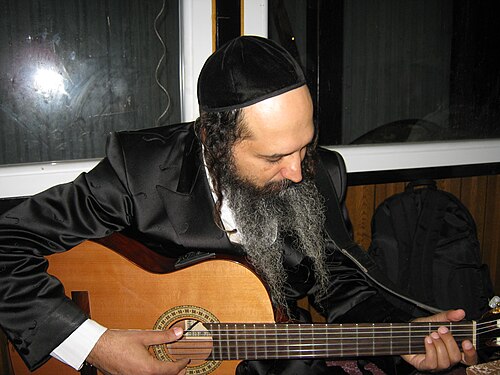
Israeli Hasidic singer and songwriter in the Breslov tradition, best known for Shir LaMaalot, from his debut album Road Marks.
View profile →Yitzchak Meir Helfgot is a Hasidic cantor, a chazzan, and holds the senior cantorial post at Park East Synagogue in New York. He sings Jewish liturgical music in synagogues and concert halls around the world.
View profile →
Yonatan Razel is an Israeli singer, pianist and composer who sets liturgical and biblical texts to music, among them the widely sung VeHi She'amda and Katonti.
View profile →Basya Schechter grew up in the Hasidic community of Borough Park and founded the band Pharaoh's Daughter in 1995, mixing Jewish song and klezmer with folk and Middle Eastern music.
View profile →Rabbi Josh Warshawsky is a composer and song leader from the Chicago area who writes melodies for Jewish prayer. He studied at Columbia University and the Jewish Theological Seminary and was ordained in 2019 at the Ziegler School of Rabbinic Studies in Los Angeles. He travels to synagogues, communities and camps to lead prayer and teach about its meaning through song.
View profile →Retreats, dialogues and online gatherings connected to this path.
Online · Weekly online class
· Weekly online gathering
Online · Weekly online meditation class
Brooklyn, New York, United States · Talmud study class
Talks and conversations from teachers within this path.
Four minutes of television from his own seminary, and the shortest way to hear him.
The earlier of his two recorded UCLA lectures, from May 1963.
An hour and a quarter of him speaking in May 1968, from UCLA's own film archive.
The full 2021 documentary on his life, from Warsaw to Selma, posted by the company that made it.
Voices from this path and the schools within it, playing from the platforms the teachers publish on.
Ten songs by Raz Hartman, the album with which he first brought his settings of Jewish liturgical and mystical verse together.
Thirteen songs on the theme of returning, which is what the Hebrew title means.
Thirteen songs on an album whose Hebrew title means "my place".
An album by Joey Weisenberg and the Hadar Ensemble of nigunim on the theme of the songs of ascent.
From the podcast Nigunim, Vol. VII: Songs of Ascent
The source texts beneath this path, free to read.
English translations of three key books of the Zohar, via Knorr von Rosenroth's Latin.
The Book of Formation — one of the oldest and most foundational texts of Kabbalistic cosmology.
Kabbalistic language of hidden light and ascending worlds can be genuinely illuminating, but was traditionally taught only to students already grounded in Torah study — symbols borrowed without that context are easy to misread.