
What does sikh path (gurmat) point to?
The Sikh path, founded by Guru Nanak in 15th-century Punjab, centres on loving remembrance of the One (naam simran), honest work and selfless service (seva). Its scripture, the Guru Granth Sahib, is composed as poetry and ordered by raga, so devotion is above all sung: in kirtan, the singing of the hymns, the community gathers around the words of the Gurus and of saints from Hindu and Sufi traditions alike. Shared meals in the langar, open to all, express the same spirit of equality and devotion.
Remembrance is not a retreat from ordinary life. It is carried in honest work, in service to others, and in the singing that gathers a community.A central teaching within Sikh Path (Gurmat)
Voices within this path.
Compare background, approach and format before choosing a teacher to follow.
Bhai Baldeep Singh
Sikh musician, musicologist and instrument maker, born in 1969, who works to bring back classical Gurbani kirtan: the scriptures sung in the ragas laid down for them. He descends from Bhai Sadharan, a disciple of Guru Nanak, in a long line of GurSikh masters of the tradition, and rebuilds by hand the string instruments it needs.
View profile →
Bhai Sahib Mohinder Singh Ahluwalia
Bhai Sahib Mohinder Singh Ahluwalia is the spiritual leader of Guru Nanak Nishkam Sewak Jatha in Birmingham, the third in its line of spiritual leaders. He was the first British Sikh to receive the title “Bhai Sahib” from the jathedars of the five Takhts. Rooted in selfless service (nishkam seva), he founded the Nishkam Centre, has worked to conserve historic places of worship in India and Kenya, and is active in interfaith dialogue; in 2012 he became the first Sikh to receive the Papal Knighthood of St Gregory the Great.
View profile →Harinder Singh
Harinder Singh is a co-founder of the Sikh Research Institute and of the Panjab Digital Library, and serves as SikhRI's Senior Fellow for Research and Policy. Having studied the linguistics of the Guru Granth Sahib, he is building an open-source reading of the scripture in present-day Panjabi and English for readers around the world. He lectures on Sikh thought and history at universities, in parliaments and in museums, and lives in the United States.
View profile →Nikky-Guninder Kaur Singh
Nikky-Guninder Kaur Singh, born in India, is a professor of religious studies at Colby College in Maine, where she has taught since 1986. She translates the hymns of the Sikh Gurus into English, as in “The Name of My Beloved”, and writes about the feminine dimension of Sikh spirituality and about Guru Nanak, including “The Feminine Principle in the Sikh Vision of the Transcendent”, “The Birth of the Khalsa” and “The First Sikh”. She also teaches at interfaith summer schools.
View profile →Dr. Gurnam Singh
Dr. Gurnam Singh is a kirtan singer and scholar of Gurmat Sangeet, the raga-based music of the Guru Granth Sahib. As founding head of the Department of Gurmat Sangeet at Punjabi University in Patiala, he brought the tradition into university teaching, and over more than thirty years he has also taught at universities abroad. He has recorded the 31 principal ragas of the Guru Granth Sahib in his own voice and has been honoured as “Shiromani Ragi” by the SGPC and the Government of Punjab.
View profile →Musicians and singers.
Devotional music and chant from within this path, alongside its teachers.
Bhai Baldeep Singh
Sikh musician, musicologist and instrument maker, born in 1969, who works to bring back classical Gurbani kirtan: the scriptures sung in the ragas laid down for them. He descends from Bhai Sadharan, a disciple of Guru Nanak, in a long line of GurSikh masters of the tradition, and rebuilds by hand the string instruments it needs.
View profile →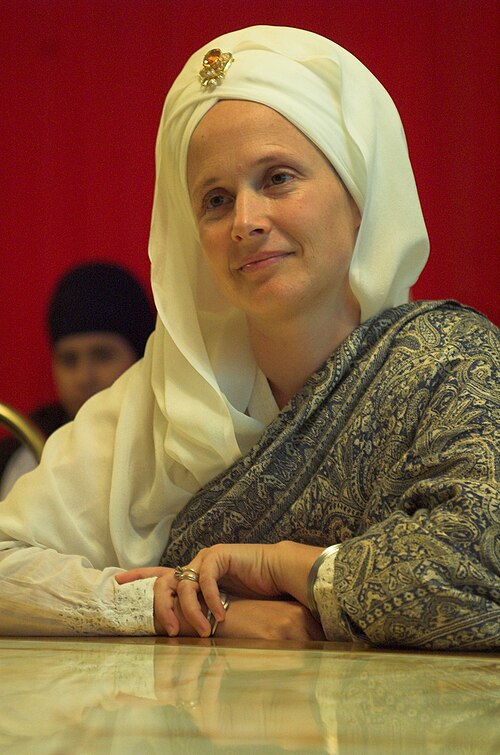
Snatam Kaur
American Kundalini Yoga-trained chant artist in the 3HO/Sikh-inspired tradition of Yogi Bhajan, known for mantra-based devotional music.
View profile →Bhai Harjinder Singh
Sikh raagi born in Ludhiana in 1958, known as Srinagar Wale, who sings Gurbani kirtan in the classical raag forms of Gurmat Sangeet. He served as Hazuri Raagi at Sri Harmandir Sahib, the Golden Temple in Amritsar, has recorded more than a hundred devotional albums carrying over six hundred shabads, and received the Padma Shri in 2025 for devotional music.
View profile →
Prof. Surinder Singh
Prof. Surinder Singh, born in 1969 in Kapurthala, founded the Raj Academy in London in 1994 to revive the string instruments of Sikh kirtan, such as the rabab, taus, dilruba and saranda. He has taught Sikh music and naad yoga in the United Kingdom, North America, Europe and India, and was a professor of musicology at Thames Valley University. His recordings, including “Anhad – Beyond Sound” and “Vaar Asa – Wisdom of Life”, present gurbani in the raga tradition on these instruments.
View profile →Bhai Anantvir Singh
Bhai Anantvir Singh is a kirtan singer whose style is rooted in the Akhand Kirtani Jatha tradition, which centres on singing the words of the Guru Granth Sahib, sometimes through the night. Having lived in Los Angeles and Amritsar, he leads kirtan at gurdwaras in India, Europe and North America and gives free kirtan workshops. In April 2025 he took part in the Darbar Festival's first interfaith concert in London.
View profile →Amrita Kaur
Amrita Kaur was born in the United Kingdom, has family roots in Malaysia and grew up in New Zealand. From the age of seven she sang kirtan with her father, the kirtaniya Bhai Yadvinder Singh, in the gurdwaras of Auckland, and at eleven she began training in Indian classical music with Professor Shukdev Madhur. She has given concerts of devotional music in Pakistan, including solo concerts in Lahore in 2023 and 2024, and in Southeast Asia, the Gulf and Australia.
View profile →Ustad Moeen Ahmed Chand
Ustad Moeen Ahmed Chand is a Muslim rababi from Lahore, the thirteenth generation of his family to sing Sikh kirtan. The rababis trace their tradition to Bhai Mardana, the Muslim companion of Guru Nanak who played the rabab as the Guru sang, and before Partition his grandfather was a rababi at the Golden Temple in Amritsar. Accompanying himself on harmonium, and performing with his nephew and disciple Mohsin Ali Chand on tabla, he continues this line of devotional song.
View profile →Dya Singh
Dya Singh, originally from Malaysia, is the son of the kirtaniya Giani Harchand Singh Bassian and has lived in Adelaide for many years, making music his full-time work since 1995. He sings shabads from the Guru Granth Sahib based on the raga system, accompanied by harmonium and tabla together with instruments from other musical cultures. He has performed at festivals in North America, Europe, Japan and Southeast Asia, and co-founded Sikh youth camps in Australia.
View profile →Upcoming events in sikh path (gurmat).
Retreats, dialogues and online gatherings connected to this path.
Selected talks.
Talks and conversations from teachers within this path.
No talks are published yet for this path.
Clarity should include the human context.
A gurdwara is open to anyone and the langar feeds anyone who comes, so this path is easy to visit. That also makes it easy to take the singing or the meal on its own, apart from the scripture and the community they belong to.