☯
Energy, breath and stillness
Daoism & Internal Arts
Embodied Daoist practice: internal alchemy, nei gong, qigong and meditation, cultivating energy, breath and stillness through the body.
Explore the path →Daoism & Internal Arts · Living Tao and Tai Ji
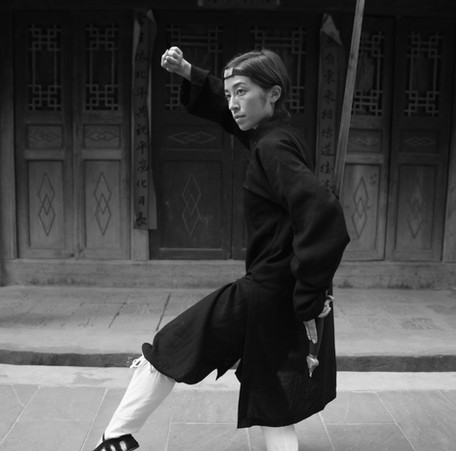
Tai Ji master, dancer and calligrapher who founded the Living Tao Foundation, and who has spent sixty years bringing Taoist practice into Western hands through movement, brush and story.
Chungliang Al Huang (黃忠良) was born in China to a family of scholars and grew up inside the classical training — tai ji, kung fu, brush calligraphy, the scholarly arts. In 1949 the family fled to Taiwan; in 1955 he went to the United States as a student, to read architecture, cultural anthropology and dance. With his wife Suzanne Pierce he founded the Al Huang Dance Company, and a Ford Foundation grant took them back to Taiwan in 1966 to pioneer modern dance there.
What he built afterwards came out of holding both halves at once. He founded the Living Tao Foundation, an international network for lifelong learning, and directs the International Lan Ting Institute at Wu Yi Mountain in China — now a UNESCO World Heritage site — and at Gold Beach on the Oregon coast. His teaching rests on what he calls the three pillars of Asian wisdom, Taoism, Buddhism and Confucianism, turned into something you can practise on an ordinary Tuesday.
His mentors read like a map of twentieth-century East-West exchange: Alan Watts, Joseph Campbell, Joseph Needham, Huston Smith, Gregory Bateson, John Blofeld. Watts called him a master in the arts of living.
The tai ji he teaches is his own reinvention of what he learned as a boy, and it is deliberately open to beginners — students tend to feel the energy move before they have any idea how. Around the movement he works with calligraphy, music, poetry, myth and the Chinese classics: the Dao De Jing, the Yi Jing, the Xin Xin Ming.
Talks, day programmes and retreats currently listed in the Paths Are Many calendar.
Short introductions and longer conversations, to hear this teacher in their own words.
No talks are published yet.
Embodied Daoist practice: internal alchemy, nei gong, qigong and meditation, cultivating energy, breath and stillness through the body.
Explore the path →